Tokenized Securities in Banking: What’s Changing Now
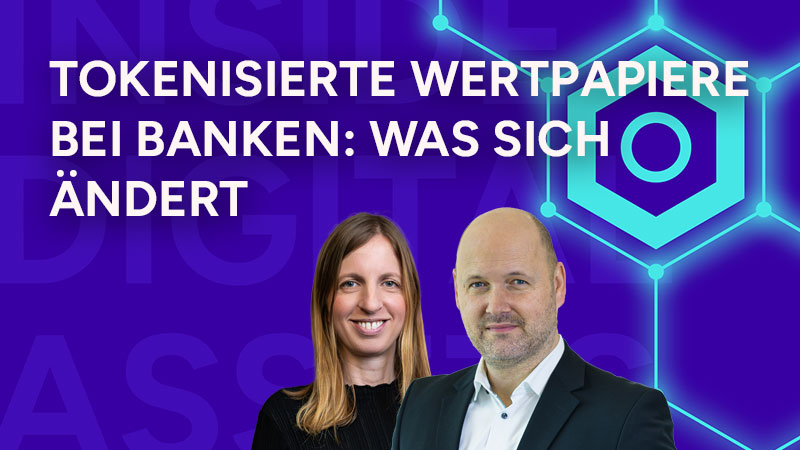
In the latest podcast episode, Lidia Kurt and Erik Haubold (Head of Private Investor Products for Central Europe at UniCredit) discuss the infrastructure perspective, concrete use cases, and how capital markets can become more efficient in the coming years.
With more than two decades of experience in securities operations, trading environments, and product structuring, Erik explains what is truly changing for banks right now and why tokenization delivers its biggest impact when clients don’t have to notice the technical complexity at all.
Why Tokenization Matters “Behind the Scenes” for Banks
From a bank’s perspective, tokenization is not an end in itself. What matters is whether new technology helps meet core requirements more effectively:
- Increase efficiency: fewer manual process steps, fewer system breaks, lower operating costs
- Reduce risk: more robust settlement processes, less friction at critical interfaces
- Simplify access: lower barriers to entry and better scalability for new offerings
- Support standardization: less fragmentation in Europe, greater interoperability
Erik Haubold describes tokenization as a field with many use cases that ideally happen “behind the scenes.” It is similar to a well-orchestrated supply chain: the customer expects the “product” to be reliably available without needing to understand every operational detail.
From Trade Sheets to DLT: How Securities Processing Has Evolved
A key element of the episode is looking back: What did securities processes used to look like, and what does that tell us about today’s transformation?
Erik describes how, early in his career, trades were sometimes documented by hand on trade sheets and then manually entered into multiple systems. The comparison makes the core point tangible: the financial sector has already gone through several technology leaps and the pace of change continues to accelerate.
For banks, tokenization is therefore not just “a new product idea,” but potentially a new tech stack with different logic for ownership transfer, process automation, and infrastructure integration.
Concrete Use Cases: Custody, Bilateral Solutions, Personalized Products
Which applications are most relevant from a bank’s perspective?
1) Custody / Safekeeping
Secure custody of digital assets and tokenized securities is a key prerequisite for scalable offerings. Custody is not only about holding assets, but also about governance processes, corporate actions, and regulatory requirements.
2) Bilateral and Institutional Solutions
DLT can create value especially where many interfaces exist today between trading, clearing, settlement, and custodians. Bilateral models or controlled networks can help deliver early efficiency gains in a realistic and manageable way.
3) Personalized Client Solutions / New Product Logic
Tokenization enables finer granularity and potentially more cost-efficient customization. This is relevant for structured products, tailored investment building blocks, or new service models without necessarily reinventing the user interface.
Why Europe Has an Infrastructure Problem in Clearing and Settlement
A recurring theme in the conversation: Europe is fragmented, particularly across clearing and custody frameworks. Different rulebooks, market practices, and technical setups make standardization expensive and complex.
This leads to three structural challenges:
- Complexity: multiple parallel frameworks increase integration and operating costs
- Inertia: change takes longer because too many dependencies exist
- Regulatory effort: common standards are harder to implement
A pan-European, DLT-based settlement infrastructure can serve as a foundation: it aims to simplify and accelerate processes and reduce risk ideally without end clients needing to understand the “engine room” in detail.
Vision: The “Life Portfolio” and 24/7-Enabled Capital Markets
One of the most illustrative parts of the episode is Erik’s vision of a “life portfolio” a portfolio where long-term investments, liquidity (cash), and everyday payments increasingly converge. Conceptually, this means:
- wealth is managed in a more integrated way
- reallocations can become more efficient
- transactions could, over time, become more immediate and more widely available
It’s important to frame this vision correctly: it requires robust standards, clear regulatory guardrails, and scalable infrastructure. In this view, tokenization is not a goal in itself, but a building block to improve market access, process quality, and usability.
Skepticism, Misconceptions, and the Role of Education
The episode also reflects market reality: skepticism is normal, especially when new technology is complex and banks face many other priorities in parallel (regulation, IT modernization, cost pressure, cyber security).
One key point: the discussion becomes easier when terms are clearly separated:
DLT/tokenization ≠ Bitcoin ≠ “unsafe currency.”
For adoption to succeed, consistent “translation work” is needed: concrete mental models, clear steps, and realistic roadmaps instead of buzzwords.
And: subscribe to our Spotify channel so you don’t miss a new episode of Inside Digital Assets!
More news from BX Digital
In this episode, we explore how Franklin Templeton, one of the world's largest asset managers, is fundamentally transforming institutional finance through tokenization.
Nasdaq’s Roland Chai discusses tokenized assets, DLT, regulated trading and the future of digital market infrastructure.